Every voice agent vendor says it supports Arabic. That tells you almost nothing. What you need to know is how well it handles your callers' Arabic, and how it behaves when a call moves between Arabic and English. The five questions below are the ones that show it, and every one of them can be tested in a single afternoon.
Why "supports Arabic" is not an answer
In the Kingdom, a call can start in Arabic and end in English. A caller may use both in one sentence, with an English product name inside an Arabic question. Arabic itself differs from one region and one speaker to the next. A demo recorded in one accent, with one clean voice, proves little about the callers you actually have.
So do not ask whether a product supports Arabic. Ask it to show you. These are the five things to put in front of any vendor, including us.
Question one: how does it greet?
The greeting is the first thing every caller hears, and it is where a bilingual line either feels natural or makes the caller work.
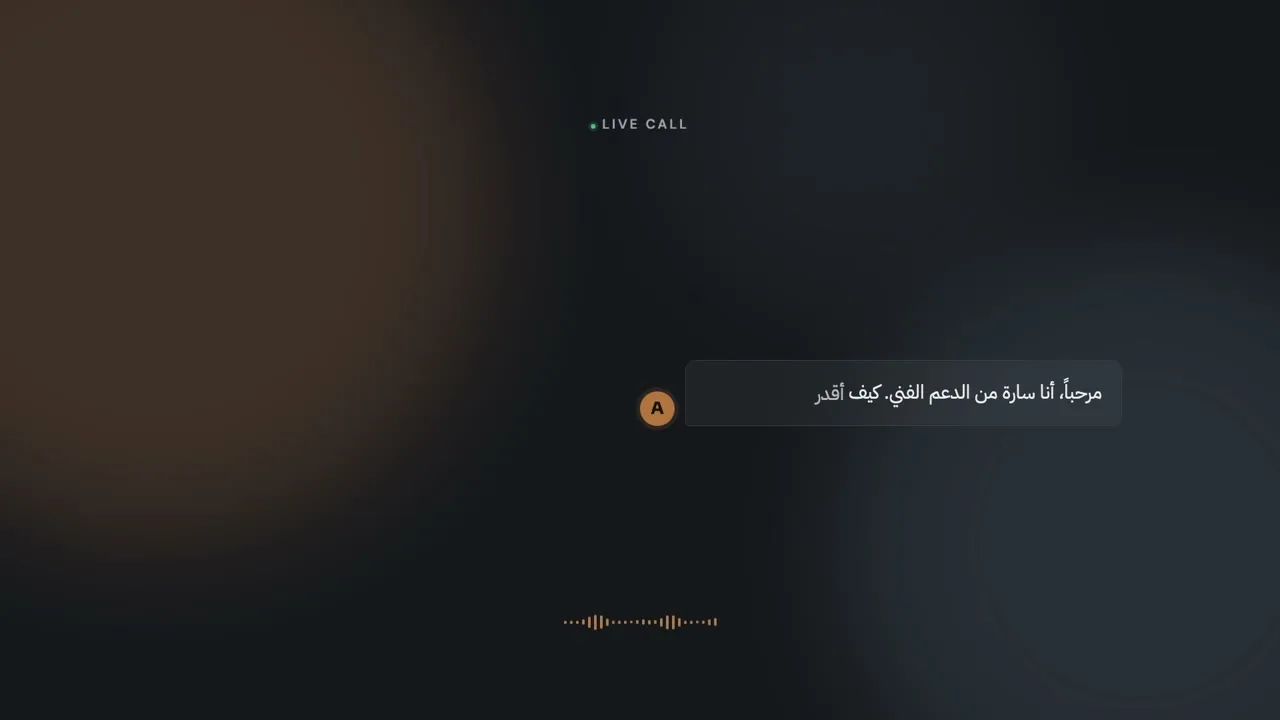
The weak version asks the caller to choose: "press 1 for Arabic, 2 for English". The better version greets in both languages and lets the caller carry on in whichever they prefer. In the AI Voice Agent demo, the agent greets in Arabic and then in English, and the caller answers in English.
Ask the vendor:
- Does the caller have to choose a language, or does the agent follow whatever they speak?
- Can I hear the greeting in both languages, and change the wording?
- Can the greeting say that the caller is speaking with an AI, and that the call is recorded? We recommend it does. Check the rules for your sector.
Question two: does it follow the caller?
Test this by calling. Speak Arabic, then English, then switch in the middle of a sentence. A good agent follows without asking "Which language?" and without losing the thread of the call.
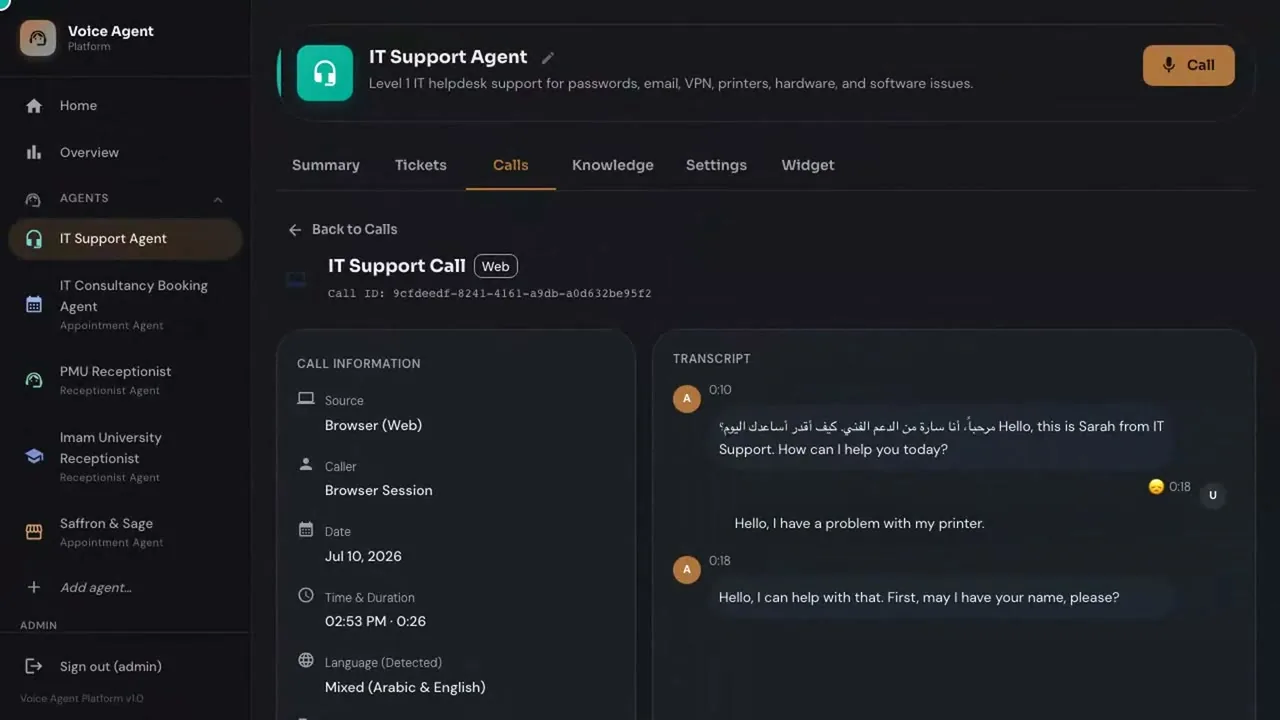
Then check the record. The call record should log the language it detected, including calls that mix both. The AI Voice Agent's call record shows "Mixed, Arabic and English" for exactly that case.
Question three: whose Arabic is it?
Dialect is the question vendors like least, so ask it first.
How well an agent follows your callers depends on the voice and the model in use. A polished demo in one accent does not carry over to another. Ask a colleague who speaks the dialect your callers use to make the test calls, and ask the vendor to demonstrate that dialect before you decide.
We say the same about our own product: dialect coverage depends on the voice and model you choose, and we will demonstrate your callers' dialect in the demo. A vendor that will not say that, or will not do that, has told you something.
Question four: what happens to names and numbers?
Names and numbers are where voice agents quietly go wrong. A mistaken digit in a phone number or an order reference is rarely noticed until someone tries to use it.
Build four tests into your call script:
- An Arabic name. Give your name and ask the agent to repeat it.
- A phone number. Read out a full number, in Arabic and then in English.
- A date and a time. Ask for a booking and check what the agent repeats back.
- An order or reference number. Mix letters and digits, then check the record afterwards.
A good agent repeats the key details back and waits for a yes before it books, creates a ticket or takes an order. That habit catches most mistakes. Whichever vendor you test, count how often it confirms and how often it simply carries on.
Question five: can your team read the result?
The call does not end when the caller hangs up. The recording, the transcript and the ticket are what your team works from.
- Is the transcript in Arabic and English, and is the Arabic readable right to left?
- Does a call that mixes both languages read sensibly in the transcript?
- Does the booking, ticket or order land in the right system, with the right details?
Check this by opening the record after your test calls. Put it next to what you actually said.
Run the test properly
Make at least five calls in each language, from at least two different people. Write down what went wrong, not only what went right. Do not rely on one recording that the vendor picked for you.
Two practical questions come with it. Voice recordings are sensitive, so ask where recordings and transcripts are stored, and where the voice is processed. With AI Hub, recordings and transcripts are stored where you choose: in KSA on a Saudi cloud provider or in your cloud account under the Cloud option, or on your servers under On-premise. Voice processing uses a third-party speech service by default, and it can run in KSA or on your servers on request. Ask every vendor for the same detail, store by store.
How AI Hub answers
The AI Voice Agent answers in Arabic and English, follows the caller between them, logs the language of every call and gives you a recording and a transcript to check. It is built to be judged. We would rather you test it on your own callers' Arabic, in the demo, before you decide.